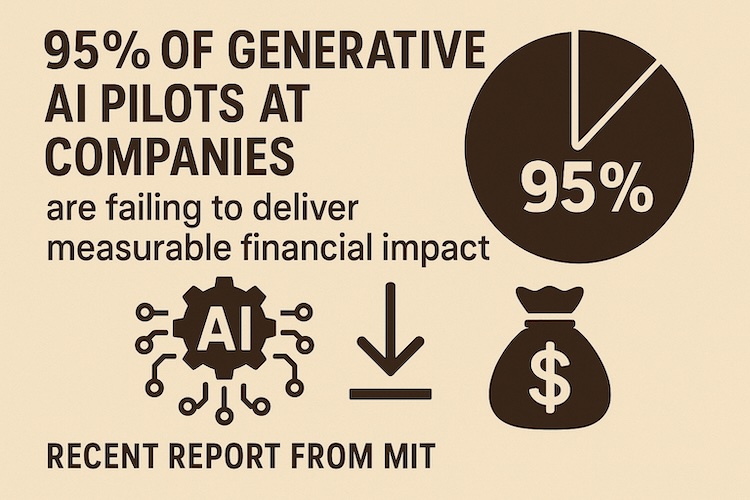
Here’s the reality: In 2026, 95% of enterprise AI pilots go nowhere financially—even after spending $30-40 billion. Companies keep throwing money at proof-of-concepts that look promising in the lab but fall flat in the real world. Budgets shrink. The board loses confidence.
If you’re a CIO or CFO, you know how this feels. The early excitement of a working demo fades fast when real-world problems start piling up and your project stalls out—stuck in endless pilot mode.
But you’re not trapped. This article gives you a proven plan for scaling AI across the business. You’ll learn how to turn those dead-end pilots into real profit, and finally see AI impact your bottom line. We’ll break down what’s holding you back and walk you through practical steps to get your AI strategy moving—and actually making money.
The Trap of “Pilot Purgatory” (And Why 85% of AI Projects Stall)
Pilot purgatory isn’t just another trendy phrase—it’s the quiet reason so many big AI dreams never get off the ground. RAND Corporation found that more than 85% of AI initiatives end up delivering nothing, which is twice the failure rate of regular IT projects. So, what’s going on? Too many teams chase flashy demos and proof-of-concepts, but never tackle the real issues that kill AI at scale.
Let’s start with the first problem: data silos. Old systems chop up your data, leaving it scattered and hard to use. Models need clean, unified data streams to actually work, but most companies can’t deliver. So, even the smartest algorithms flounder when it’s time to move beyond the lab.
Next up: no real AI operating model. Teams often run random experiments without any structure or rules. There’s no clear pipeline to get from prototype to production, which creates compliance headaches and spotty performance.
And then there’s the human factor. People don’t love change—especially when new tech messes with how they already do things. If you ignore change management, expect your shiny new tools to collect dust while adoption rates flatline and your AI investment goes nowhere.
Stack these problems together, and that promising AI pilot turns into a money pit. Gartner’s not optimistic either—they say that by 2026, 60% of AI projects without enough ready data will just get scrapped. If any of this sounds familiar, you’re definitely not the only one. But if you keep ignoring these roadblocks, you’ll be stuck tinkering while your competitors turn AI into a real advantage.
| Culprit | Impact on Scaling | Mitigation Tip |
|---|---|---|
| Data Silos | Fragments inputs, causes inaccuracies | Implement centralized data lakes |
| No AI Operating Model | Leads to compliance risks | Adopt LLMOps for governance |
| Poor Change Management | Low adoption rates | Use human-in-the-loop designs |
The 4-Step Blueprint to Scale Enterprise AI for Maximum ROI
Scaling AI isn’t just about piling on more tech. You need everyone pulling in the same direction. This blueprint helps you escape endless pilots and actually turn your AI investments into profit. Here’s how to get real enterprise AI results—without wasting time or money.

1. Move From “Tech-First” to “Value-First” Architectures
Don’t get distracted by flashy new models. Focus on solving real business problems. Chasing the latest LLM just for the sake of it eats up resources fast, and you end up spinning your wheels.
Start by tying your data architecture directly to what matters—like predictive maintenance or fraud detection. Break down data silos and set up centralized data lakes or federated systems, so teams get real-time access without having to rebuild everything from scratch.
What happens then? Your models get trained on better data, which means faster, sharper insights. One client cut their data prep time by nearly half and unlocked $2 million in savings every year. When you put value at the center, you avoid the usual headaches and actually see a return.
But here’s the thing: You need buy-in from every corner, right from the start. Bring finance to the table early—let them help define the ROI you’re aiming for.
2. Standardize Your AI Operating Model (LLMOps)
Enough with the chaos. Treat AI like any other critical business asset—get some rules in place so you can actually scale.
Start using LLMOps for your large language models. Set up automated pipelines for training, deployment, and monitoring. Add version control, bias checks, and solid security so you’re ready for whatever regulations come your way.
Centralize your infrastructure with a hybrid cloud setup. It gives you the flexibility to handle whatever workload comes up. This approach cuts deployment times from months down to weeks and makes downtime way less likely.
Here’s a tip: Start with one business unit. Once you’ve got it working, expand from there. Companies with mature operating models pull off three times as many successful AI projects, according to Gartner. Standardize now, or you’ll spend a fortune fixing things later.
3. Get a Grip on Compute Costs
AI’s not cheap. If you’re not careful, compute and token costs can spiral out of control—especially now, when inference actually costs more than training and output tokens can be four times pricier than inputs.
Track what you use: watch your API calls, GPU hours, memory—all of it. Swap in smaller models like Llama 3.1 for the basic stuff and save big compared to running the big names.
Set up a tiered system: send easy questions to cheaper models, save the heavy-duty ones for the tough problems. Don’t ignore the hidden extras—network fees, storage, retraining costs—they add up fast and can blow out your budget by as much as 30% a year.
The upside? When you manage this right, AI becomes a real growth engine, not just a money pit. One CFO cut cloud expenses by 35% and tripled their AI output. That’s how you boost your ROI and scale the right way.
4. Nail “Human-in-the-Loop” Change Management
Tech scales easily; people don’t. If your teams aren’t on board, your AI projects stall out and never deliver.
Get people involved from day one. Build workflows where AI helps your teams do their jobs better, not just replaces them. Train everyone on the new tools and show them how it’ll make their work easier.
Be upfront about the changes. Address worries directly and create feedback loops so people can share what’s working and what’s not. Track adoption with real usage data and surveys.
The result? People stick with it, engagement goes up, and the ROI keeps growing. Deloitte found that teams with strong change management see results twice as good. Get this right, and your AI becomes a core part of how you do business.
Measuring What Matters: Proving Enterprise AI ROI
CFOs don’t want buzzwords—they want proof. Forget vague talk about “productivity.” When you scale enterprise AI, focus on the hard numbers that actually move your business forward.
Here’s what matters:
| Metric | Description | Typical Impact |
|---|---|---|
| Time-to-Market Reduction | Accelerates product launches | Shaves weeks off cycles |
| Customer Acquisition Cost (CAC) Savings | Targets campaigns precisely | Lowers CAC by 15-25% |
| Error Rate Reduction | Cuts errors in ops/finance | Reduces by 30-50% |
| Days Sales Outstanding (DSO) Improvement | Prioritizes collections | Reduces DSO by 5-15 days |
| Cost-to-Serve Metrics | Automates routine tasks | Drops per-customer costs |
| Risk Mitigation Savings | Avoids losses from fraud | Quantifies avoided fines |
Frequently Asked Question:
1. What’s “pilot purgatory” in enterprise AI?
It’s when AI projects get stuck in endless test phases. They never make it to full rollout, usually because of messy data, clunky processes, or teams that just don’t buy in. The result? Wasted money and almost no real return.
2. How do you actually figure out enterprise AI ROI?
Don’t guess—measure it. Look at solid numbers like customer acquisition cost (CAC) savings or fewer errors. Start with your numbers before AI, then track what changes after you launch. That’s how you see what’s working as you scale up.
3. Why do most companies stumble when trying to scale enterprise AI?
Three big reasons: data lives in silos, there’s no operating model like LLMOps to keep things organized, and change management falls flat. Any of these can kill your chances at real, company-wide impact.
4. So, what does LLMOps actually do?
It gives you a playbook for training, deploying, and governing AI models. This kind of structure makes it way easier to roll out AI at scale. Plus, you keep costs and risks in check, so the investment actually pays off.
5. How do hidden compute costs impact AI cost management in 2026?
And about costs—hidden compute charges are a real headache, especially now. Token and inference costs alone can eat up 20-30% more than you planned for. To keep budgets under control, you need to get smart: tier your models, run regular audits, and keep a close eye on spending. That’s how you stay profitable as you grow.
Here’s the bottom line:
Scaling enterprise AI means breaking out of pilot purgatory and turning scattered experiments into real, repeatable value. Fix your data problems, get your operations locked down, watch costs, and make sure people actually use the tools. That’s how you turn every dollar into real results.
The era of experiments is over—it’s time to build for profit. So, what’s holding you back: data, operations, costs, or people? Find your biggest blocker, get to work, and watch your bottom line change. Your competitors aren’t sitting around. Why should you?
Hashtags
#ScaleEnterpriseAI #EnterpriseAIROI #AIPilotPurgatory #AIImplementationStrategy #LLMOps #EnterpriseAutomation #AICostManagement